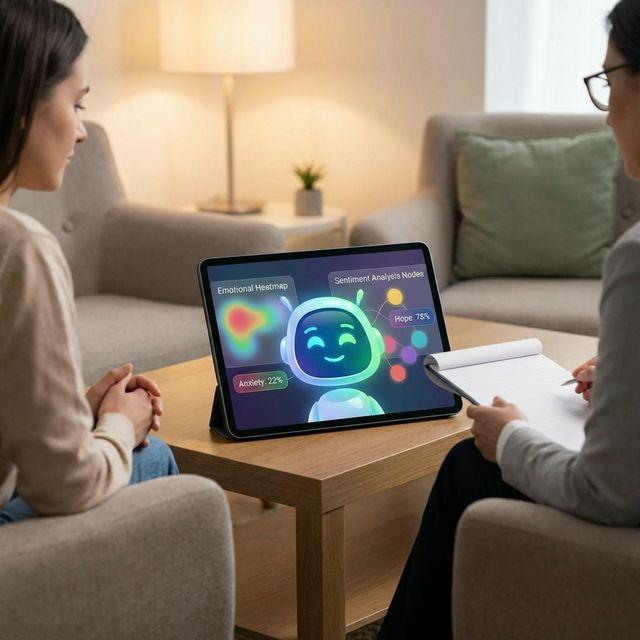
AI-Powered Psychological Assessment Assistant for Mental Health Clinics
Mental health clinics, psychologists, and psychiatry departments face significant challenges in maintaining consistent, high-quality psychological assessments while managing increasing patient volumes. Traditional intake processes are time-consuming, documentation is often inconsistent, and clinicians struggle to track patient symptoms effectively between sessions. A leading mental health services provider approached Vimix Technologies to transform their clinical workflow through AI-powered automation and intelligent documentation systems.
Project Overview
The Challenge
The client's primary challenge was to streamline the psychological assessment process while maintaining clinical accuracy and compliance with DSM-5-TR and ICD-10/11 standards. They needed a solution that could reduce documentation overhead, standardize intake processes across clinicians, improve symptom tracking continuity, and enhance patient engagement—all while keeping clinicians in control of final decisions and maintaining strict data privacy standards.
Our Solution
Through this project, Vimix Technologies successfully demonstrated how Generative AI can transform mental health clinical workflows while maintaining the highest standards of patient care and data security.
Project Details
Quick Actions
Our Approach
Conversational AI Intake System
Developed an advanced Generative AI-powered conversational interface that conducts comprehensive patient intake covering personal, medical, social, and symptom history. The system uses natural language processing to ask contextual follow-up questions, synthesize patient responses into structured clinical profiles, and adapt questioning based on patient responses—creating a more natural and thorough intake experience.
DSM-5-TR and ICD-10/11 Aligned Symptom Mapping
Implemented intelligent symptom classification algorithms that automatically map patient-reported symptoms to standardized DSM-5-TR diagnostic criteria and ICD-10/11 classification codes. This ensures clinical documentation maintains professional standards while providing clinicians with structured, comparable data across patient sessions and therapists.
Automated Clinical Documentation Generation
Built an AI-powered documentation engine that generates structured clinical reports including initial assessments, SOAP notes (Subjective, Objective, Assessment, Plan), and risk summaries. The system maintains clinician oversight with review and edit capabilities while dramatically reducing the time spent on administrative documentation tasks.
Patient Self-Reporting and Symptom Tracking
Created a patient-facing mobile and web interface enabling daily mood and symptom check-ins between therapy sessions. The system tracks symptom trends over time, identifies patterns, and alerts clinicians to significant changes or risk indicators, enabling more proactive and informed therapeutic interventions.
Clinician Dashboard with Risk Indicators
Designed a comprehensive clinician dashboard providing real-time visibility into patient symptom trends, risk indicators, treatment progress, and upcoming sessions. The dashboard integrates AI-generated insights with traditional clinical data, supporting evidence-based decision-making while maintaining the clinician's authority over all treatment decisions.
Secure, Compliant Data Architecture
Implemented enterprise-grade security with end-to-end encryption, role-based access controls, HIPAA compliance, and audit logging. The system ensures patient data privacy while enabling seamless integration with existing Electronic Health Record (EHR) systems and maintaining complete data sovereignty for the healthcare organization.
Impact & Results
50% Reduction in Assessment and Note-Taking Workload
Automated intake and documentation generation freed clinicians from repetitive administrative tasks, allowing them to focus more time on direct patient care and therapeutic interventions.
Standardized Intake Processes Across Therapists and Clinics
AI-driven standardization ensured consistent, comprehensive assessments regardless of which clinician conducted the intake, improving care quality and facilitating better collaboration across multi-clinic networks.
Improved Clinical Insight Through DSM/ICD-Aligned Symptom Structuring
Standardized symptom mapping enabled better pattern recognition, more accurate diagnosis support, and improved treatment planning through consistent, comparable clinical data.
Higher Patient Engagement Through Pre-Session Interaction
Daily symptom check-ins and self-monitoring tools increased patient awareness of their mental health patterns and provided valuable data points that enriched therapy sessions and treatment outcomes.
Scalable for Solo Practitioners, Group Practices, and Multi-Clinic Networks
The modular platform architecture supports deployment across diverse practice sizes—from individual therapists to large healthcare systems—with flexible configuration options and seamless scaling capabilities.
Technology Stack
Generative AI & LLM
Clinical Standards Integration
Backend & API
Frontend
Database & Storage
Security & Compliance
Cloud Infrastructure
Integration
Related Services & Industries
Services Used

Secure AI Adoption
Implement artificial intelligence securely while maintaining data privacy and regulatory compliance....

Privacy & Data Protection
Comprehensive data protection strategies to safeguard sensitive information and maintain customer tr...

Cyber Risk & Compliance Advisory
Navigate complex compliance requirements and manage cyber risks effectively....


Project Conclusion
Through this project, Vimix Technologies successfully demonstrated how Generative AI can transform mental health clinical workflows while maintaining the highest standards of patient care and data security. The AI-Powered Psychological Assessment Assistant not only reduced administrative burden but also enhanced clinical quality through standardization, improved patient engagement through continuous monitoring, and provided scalable solutions suitable for practices of all sizes. By combining cutting-edge AI technology with deep understanding of clinical workflows and compliance requirements, Vimix has positioned itself as a leader in healthcare AI innovation. This solution represents a new paradigm in mental health technology—one where AI enhances rather than replaces clinical expertise, enabling mental health professionals to deliver better care more efficiently.