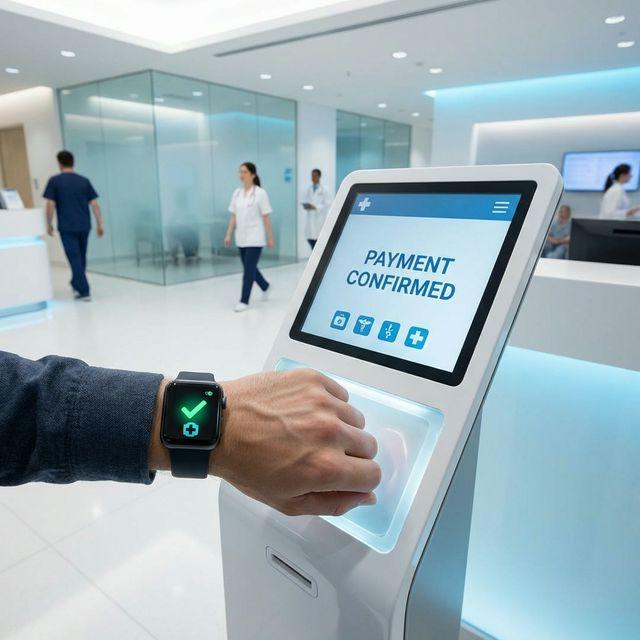
How We Can Help Hospitals Implement Cashless Transaction Systems with AI
Back to Company
Healthcare & AI

How We Can Help Hospitals Implement Cashless Transaction Systems with AI

A technical blueprint for NFC-based payments, AI-driven eligibility, and intelligent payment routing in healthcare

February 5, 2025
Vimix Healthcare & Data Practice

Hospitals can modernize revenue cycles and patient experience by combining NFC-based cashless transaction systems with AI for eligibility verification, fraud detection, payment routing, and reconciliation. This report outlines architecture, integration patterns, and implementation considerations for CIOs and healthcare operations leaders.

01

Introduction: Why Cashless and AI in Hospitals

Hospitals face persistent challenges: delayed payments, manual eligibility checks, reconciliation errors, and patient friction at the point of care. A well-designed cashless transaction system—powered by Near Field Communication (NFC) and complemented by AI—can reduce administrative burden, accelerate revenue recognition, and improve patient satisfaction. This report describes how Vimix helps hospitals implement such systems, with a focus on technical architecture and AI use cases.

02

NFC Transaction System: Architecture and Standards

NFC enables contactless payment and identification at the point of care. For hospitals, we recommend a layered architecture:

Reader layer: ISO/IEC 14443-compliant NFC readers (e.g. PN532, RC522, or certified POS terminals) at registration desks, pharmacy counters, and discharge kiosks. Readers support both card emulation (patient’s phone or card) and reader mode (scanning wristbands or tags for patient identification).
Secure element and tokenization: Payment credentials should never pass through hospital systems. We integrate with PCI-DSS-compliant payment gateways that support tokenization; the NFC reader captures a tokenized payment method, and the hospital only receives a transaction reference and outcome. This keeps cardholder data out of scope for the hospital’s compliance footprint.
Protocol stack: Communication between reader and backend uses standard APIs (e.g. REST or gRPC) over TLS. We typically deploy a small edge service at each site that normalizes reader output, enriches with location and terminal ID, and forwards to a central transaction orchestration layer. This allows consistent logging, idempotency, and retry logic across all points of care.

1NFC and Patient Identification

Beyond payment, NFC can link a patient’s wristband or phone to the EHR and billing system. When a patient taps at registration or before a procedure, the system retrieves the correct episode and account. We use a secure, short-lived identifier (e.g. HMAC of patient ID + encounter ID + nonce) so that NFC taps do not expose raw PII on the wire.

2Offline and Low-Connectivity Scenarios

In areas with unreliable connectivity (e.g. rural or mobile units), we design for offline-first: the reader and edge service buffer transactions and sync when the link is restored. Reconciliation and conflict resolution are handled by a central service that uses sequence numbers and idempotency keys to avoid duplicate charges.

03

AI in Eligibility Verification and Authorization

Determining whether a patient’s insurer will cover a procedure has traditionally been a manual or batch process. We integrate AI to improve speed and accuracy:

Real-time eligibility checks: APIs to payers (e.g. X12 270/271, FHIR CoverageEligibilityRequest/Response) are called at or before point of service. AI models pre-fill likely coverage and co-pay based on historical patterns (e.g. plan type, procedure codes, patient demographics), reducing latency and fallback to manual verification.
Prior authorization prediction: Machine learning models trained on historical authorization outcomes can predict the probability of approval and suggest documentation or alternative codes that improve approval rates. This is implemented as a decision-support layer: the final decision remains with the payer, but staff are guided toward higher-success submissions.
Anomaly detection: AI flags cases where eligibility or authorization results deviate from expected patterns (e.g. sudden change in plan behavior, duplicate requests), enabling early intervention and fraud prevention.
04

AI for Fraud Detection and Abuse Prevention

Cashless systems increase transaction volume and electronic trails; they also attract fraud. We apply AI in the following ways:

Transaction scoring: Each payment or claim is scored for fraud risk using features such as amount, time, location, patient history, and provider behavior. Models are trained on historical chargebacks and confirmed fraud; we use supervised learning (e.g. gradient boosting or neural networks) with careful handling of class imbalance and regulatory constraints (e.g. explainability for disputed cases).
Network analysis: Graph-based models capture relationships between patients, providers, devices, and accounts. Unusual clusters or referral patterns can indicate organized abuse. These analyses run in batch or near real time depending on the hospital’s risk tolerance.
Behavioral biometrics: Where applicable (e.g. patient-facing kiosks), behavioral signals—keystroke dynamics, session patterns—can supplement identity verification and detect account takeover. All such use must comply with privacy regulations and consent.
05

AI in Payment Routing and Reconciliation

Hospitals often must split a single encounter across multiple payers (primary, secondary, patient responsibility). We use AI to optimize routing and reconciliation:

Smart payment routing: Rules and ML models decide how to allocate a payment (e.g. to insurer A first, then B, then patient balance). Models can learn from past successful collections to suggest optimal order and timing, and to recommend when to trigger follow-up or write-off.
Automated reconciliation: Matching incoming remittances (ERA/EFT or bank files) to open receivables is error-prone when done manually. We deploy matching engines that use fuzzy logic, probabilistic linking, and learning from auditor corrections. Discrepancies are flagged for human review with suggested resolutions.
Cash flow forecasting: Time-series and causal models use historical payment and eligibility data to forecast cash flow by service line and payer, supporting treasury and operational planning.
06

Integration Architecture and Security

A hospital cashless system must integrate with EHR, billing, payer gateways, and banking. We recommend:

Central transaction orchestration: A single service receives all payment and eligibility events, applies business rules and AI outputs, and dispatches to downstream systems (EHR, billing, general ledger). This keeps logic in one place and simplifies audit and change management.
Event-driven design: Events (e.g. “payment initiated”, “eligibility received”) are published to an internal message bus (e.g. Kafka, RabbitMQ). Subscribers update patient balance, trigger statements, or feed analytics. This decouples NFC readers and gateways from core hospital systems and improves resilience.
Security and compliance: All flows must align with HIPAA (or local equivalent), PCI-DSS (where card data is involved via gateway), and data residency requirements. We use encryption in transit and at rest, role-based access, and audit logs for every touchpoint. AI models are trained on de-identified or synthetic data where possible; production inference uses minimal PII and is logged for compliance.
07

Implementation Roadmap and Vimix Role

We help hospitals move from design to go-live in phased steps:

Phase 1 — Foundation: Deploy NFC readers and edge services at selected high-volume points (e.g. registration, pharmacy). Integrate with one payment gateway and one major payer for eligibility. Establish transaction logging and reconciliation baseline.
Phase 2 — AI layer: Introduce eligibility prediction, fraud scoring, and reconciliation assistance. Train models on historical data; run in shadow mode before enabling decision support and then automated actions where appropriate.
Phase 3 — Scale and optimize: Extend NFC and AI to additional locations and payers. Tune models using production feedback. Add forecasting and advanced analytics for revenue cycle management.

Vimix provides architecture design, integration development, AI model training and deployment, and ongoing support so that hospitals can run cashless transaction systems that are secure, compliant, and increasingly intelligent over time.

Tags:
HealthcareCashlessNFCAIEligibilityFraud DetectionPayment RoutingHospital IT
Contact Us

Ready to Ensure DPDP Act Compliance?

Schedule a free consultation with our DPDP Act compliance experts to assess your current posture and develop a customized migration roadmap.